Summary (by AI): I found the Iron Bridge in Shropshire to be a tremendous, world-changing piece of industrial British heritage, and the beautiful walk through the valley left me feeling proud and nicely relaxed.
Blog: The Iron Bridge in Shropshire is one of those places where I’m honestly not a hundred percent sure if I’d been there before. When I arrived, it didn’t really ring a bell. That’s either because I’ve completely forgotten a previous visit, or I’m just getting too old to remember it—which, let’s be honest, is basically the same thing. It’s entirely possible I haven’t actually been there at all. Who knows?
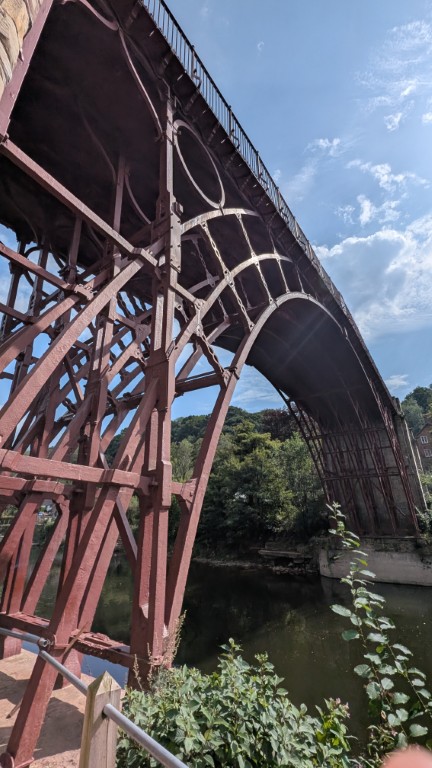
Regardless of my memory, what a tremendous piece of industrial British heritage it is. Built around 1776, it stands as a monument to the era. The process of creating the iron that went into the bridge was actually pioneered nearby in Coalbrookdale, and from that point on, it essentially turbocharged the Industrial Revolution. That specific pattern for the bridge and the ideas behind it didn't just push across the UK—they reached across the entire world.

It did wonders for the local infrastructure, too. The gorge where the bridge sits—with the river running deep underneath—is a beautiful, steep-sided valley. Before the bridge, it was incredibly difficult to get from one side to the other. Opening that up changed the local industry forever.
I had a moment of confusion regarding who built it. In my head, I was thinking of Isambard Kingdom Brunel, but of course, that’s the wrong bridge and the wrong city—Brunel is Bristol, and here we are way up in Shropshire. It was actually designed by the architect Thomas Farnolls Pritchard and cast by Abraham Darby III, whose family had pioneered the iron-smelting process in the area.

I ended up doing a fantastic walk up the valley, starting from where I was staying at the Iron Bridge YHA. I headed past the bridge and did a big loop through the area. As it turns out, that valley is home to three or four great little pubs. Once I’d finished the lion’s share of the walk and started heading back, I figured I’d stop for a pint.
I looked at a place that directly overlooks the bridge, but it felt a bit too "touristy" and was ridiculously expensive, so I kept moving. Instead, I walked back toward my accommodation and found a few different pubs on the way down that sit right up against the banks of the river, like The White Hart, The Swan Taphouse, and The Water Rat. Had a pint in each and was nicely relaxed when I got back to the YHA

Sitting there, watching the water... it was just a beautiful walk and an amazing bit of history. It really makes you proud of that British heritage.
The Map: