Summary (by AI): I enjoyed a quintessential Somerset experience by hunting down and drinking traditional mead, which I found deeply connected to the region's history and monastic past.
Blog: Mead had to appear somewhere on my list. It is, after all, the world’s oldest alcoholic drink, with evidence of its existence dating back tens of thousands of years—way, way before beer and wine were ever invented. While there are plenty of places I could have chosen for wine, as I was researching traditional drinks for Somerset, mead kept regularly popping up.
So, I hunted some down. I managed to buy a bottle at the Hecks Farm Shop in a place called Street, which is very close to Glastonbury.
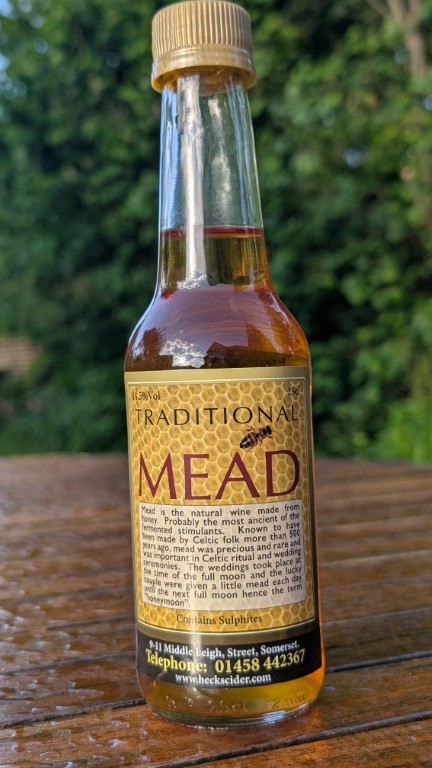
When you do a bit of research into mead, you quickly realize there is a fascinating theory about how it became so popular in this region. While it has existed in various forms all around the world, it was heavily popularised in England by monks around the 15th and 16th centuries—and perhaps even earlier.
Historically, there was a high concentration of monks in and around Somerset because of the flats and the Somerset Levels. To keep their religious ceremonies running, monasteries required an enormous amount of beeswax to make candles. Because they burned so many candles, they had to keep massive colonies of bees. Glastonbury Cathedral and Monastery, in particular, hosted huge colonies because the surrounding flatlands were absolutely carpeted with wildflowers.
The monks would extract the pure, high-grade honey to sell, but they were left with mounds of wax still heavily laden with sticky, sweet remnants. To clean the wax for candle-making, they would soak it all in water. The result of this washing process was a highly concentrated sweet water. Basically, in the 13th and 14th centuries, mead was almost a byproduct of the candle-making process—which was itself a byproduct of the church's daily religious ceremonies.
Of course, it isn't alcoholic at that initial stage; you still have to ferment it. According to the research I've done, fermenting honey is a far more complex chemical process than brewing a simple beer. The yeast has a completely different set of chemicals and sugars to contend with compared to the barley used in beer making. But we won't get too bogged down in the science of that.

My hunt for Somerset mead also led me to a place called the Avalon Wine Store, which had popped up quite a bit in my initial AI-assisted research. Google maps had flagged it as permanently shut, but I thought I’d drive up there anyway. The shop sits right in the foothills of the Glastonbury hills, overlooking the site of the Glastonbury Festival. Having never been to that particular part of the world before, I decided to make a beeline for it—see what I did there?
It was a brilliant drive, but Google was correct: the shop was firmly shut, as you can see in my photos. Interestingly, the bloke who used to run it has moved his operations and now runs Avalon Wines and Mead out of Hampshire. However, he has kept all of the mythical Avalon branding, imagery, and marketing history intact, so you'd still easily think it was coming straight from the heart of Somerset.
Instead, I bought my mead at the Hecks Farm Shop. While I was paying, I was chatting with the guy behind the counter about it.
"Oh, yeah," he told me in a thick local accent, "it's not so big over here in Street. But over in Glastonbury? Mead is huge. It's full of hippies and wizards and like that over there. They absolutely love mead, buy enormous amounts of it, and drink it constantly."

He wasn't wrong—it certainly felt like the right drink for the landscape. I ended up drinking my mead back at the campsite (which you can read about in my Somerset camping entry) while eating a homemade, cider-based pork stew. It was a proper, quintessential Somerset experience.
The Map: